
Regulation & Voicing: For the perfect feel & the ideal timbre
Your piano is freshly tuned, but something is missing? The feeling of playing is “sluggish”, “sluggish” or “uneven”? You can’t play really quietly (pianissimo) anymore? Or the sound is too “pointed”, “metallic” or “dull” for you?
When the tuning alone is no longer sufficient, the high art of piano making begins: the regulation of action and the voicing of the hammers.
These two processes are crucial to the character and soul of your instrument. Here, as a master of the piano, I ensure that your piano not only sounds right, but also feels precise and unfolds its most beautiful timbre.
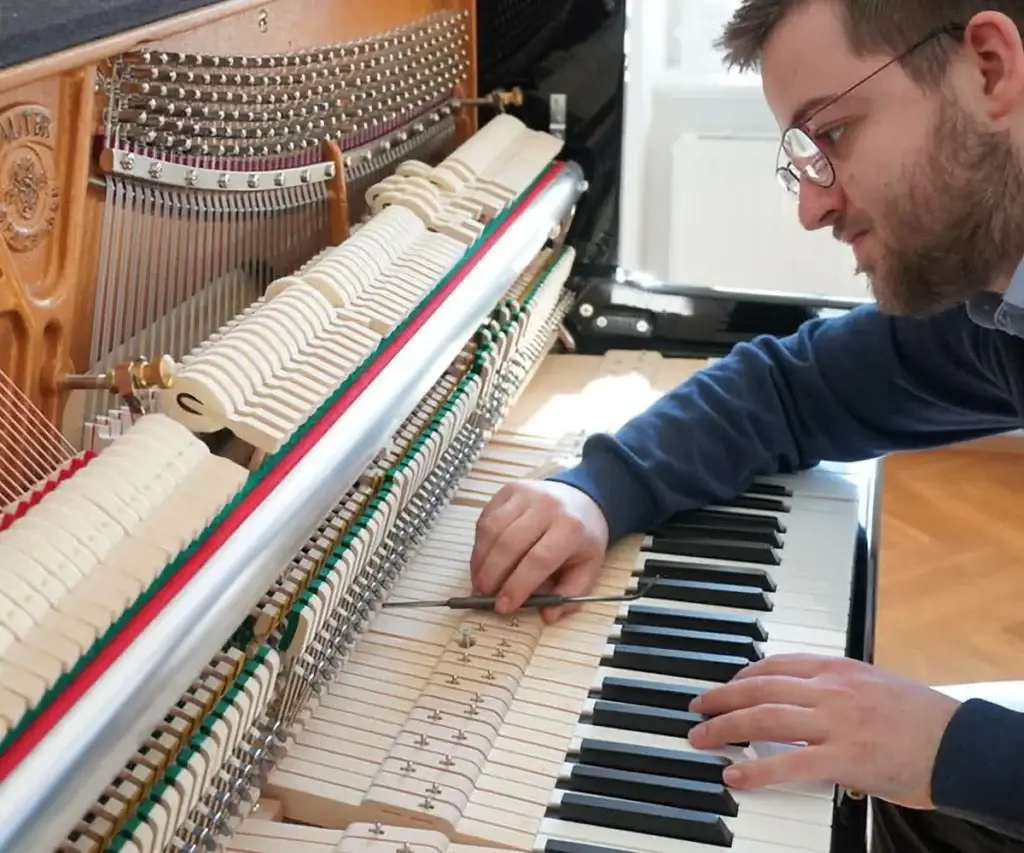
The regulation: for the perfect feel
The action of a piano or grand piano are a marvel of precision with thousands of parts that have to interact exactly to a fraction of a millimeter.
- The problem: Through years of playing and climatic fluctuations (humidity), felts and leather wear out, wooden parts change minimally. The precise setting is lost.
- The episode: The keys react unevenly, the playing feel becomes spongy, the dynamics (control over loud/quietly) suffers.
When adjusting, I adjust the entire mechanism – from the button to the levers to the hammer head – to hundreds of adjustment points. I make sure that the power of your fingers is transferred to the string optimally and without loss.
Your added value: You get back an instrument with an exact, even and responsive feel. Often the difference is as clear as playing on a new instrument.
The voicing: for the perfect timbre
The voicing (also “sound color design”) is perhaps the most demanding work on the piano. It has nothing to do with the pitch (tuning), but only with the character of the tone.
- The problem: The hammer head felts compact through thousands of stops and become hard. The sound becomes “pointed”, “hard”, “cold” or “metallic”. Conversely, an instrument can also sound “woolly” or “lifeless”.
- The solution: As a master piano technician, I work the hammerhead felts with special voicing needles.
Targeted piercing loosens the felt in the right places to restore elasticity. This is how I can shape the timbre.
Your added value: I adapt the sound of your piano to your personal wishes. Whether you prefer a softer, warmer, more vocal tone or a more brilliant, clearer sound – the voicing brings out the most beautiful timbre from your instrument.
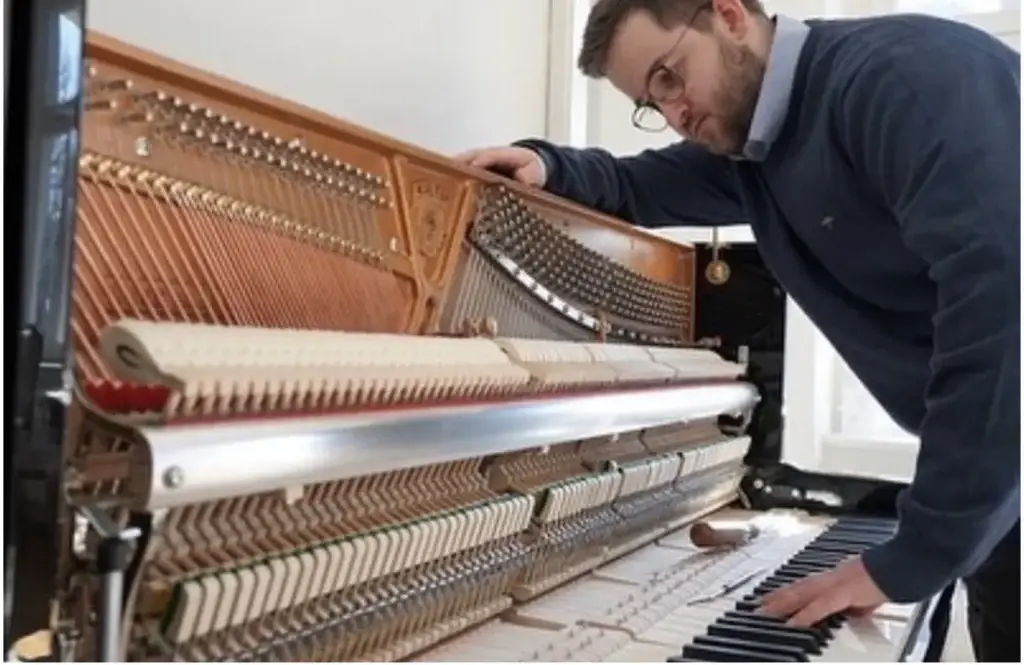
My claim: the interplay of tuning, regulation & voicing
A piano is only perfect when all three pillars are in harmony: the pure tuning, the precise regulation and the right voicing.
This fine work requires the highest sensitivity, experience and well-founded training, as I was able to enjoy with renowned manufacturers such as Steingraeber & Söhne and Bösendorfer.
Discover the real potential of your piano
If you have the feeling that your instrument could be “more” – be it at the stop or in the sound – contact me. I advise you honestly and comprehensively.
Frequently Asked Questions about Regulation & Voicing
What is the difference between tuning, regulation and voicing?
greatly simplified:
- tuning: affects the pitch (is the sound correct?).
- regulation: affects the feel (how does the button react?).
- voicing: affects the timbre (how does the sound sound – soft, hard?).
How often does a piano need regulation?
Much less than a tuning. Depending on the intensity of use, I recommend a review or partial regulation of the action every 5 to 10 years. Complete factory regulation is often only necessary after decades.
My piano is new, but is “heavy”. Does it need regulation?
That’s possible. New instruments often have to “set up” first. The felts and wooden parts adapt to your room climate. A post-regulation after the first year can often significantly improve the gaming feeling and is a normal process.
Is it possible to intonate every piano “softly”?
Yes, almost always. If a piano sounds too “pointed” or “hard”, this is usually due to hardened hammerhead felts. By intoning (loosening the felt) I can make the sound character much softer and more pleasant again.
Is regulation or voicing expensive?
This work is significantly more time-consuming than a standard tuning. A complete regulation of the action can take many hours. It is an investment in the quality and feel of your instrument. After a precise assessment, I will always make you a transparent offer.
You will find more answers on the Frequently Asked Questions page.